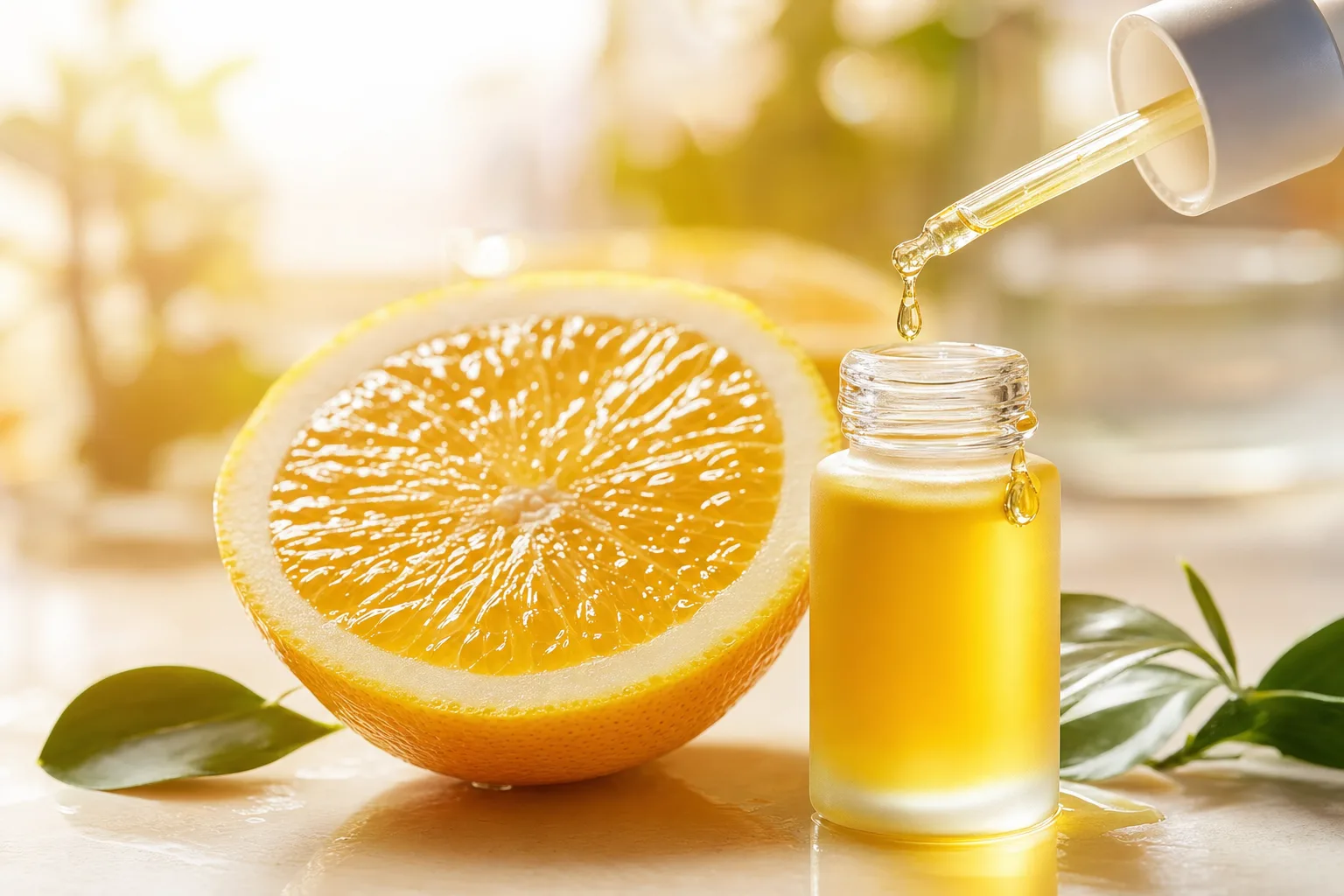
Vitamin C (L-ascorbic acid) is a hard-working ingredient that does several things at once. It mops up the free radicals (oxidative stress) that speed up aging, brightens dull skin and supports the collagen behind firmness. It neutralizes the free radicals that UV, pollution and stress leave behind, and it slows the melanin that turns into dark spots so skin reads clearer. The catch is that it is a fussy ingredient. Its form, its concentration and how you store it all change how well it works.
The short version Pure L-ascorbic acid is used by the skin as is, with no conversion step, but it goes off quickly once it meets air and light. If you want stability, a derivative like SAP or MAP is the safer bet. Pairing it with vitamin E lets the two reinforce each other's antioxidant effect.
At a glance
Also known as
L-ascorbic acid, Ascorbyl glucoside, SAP, MAP
Family
Vitamin C derivative / antioxidant
EWG rating
1–3 (depends on the form)
Pregnancy & breastfeeding
Generally considered usable (check with your doctor)
It dials down the enzyme that builds melanin (tyrosinase) so fresh pigment has a harder time forming. It also nudges melanin that has already settled back toward a lighter shade. Stick with it for four to twelve weeks and dark spots, melasma and sun-driven discoloration slowly start to fade.
2. Antioxidant defense
It neutralizes the free radicals that UV and air pollution create, which keeps skin cells from being damaged. It is especially good at shielding skin from oxidative stress during daylight hours.
3. Support for collagen
It acts as a building block that helps the collagen-making enzyme (prolyl hydroxylase) do its job, which in turn supports collagen production deep in the skin (the dermis). The payoff shows up as softer fine lines and a bit more bounce over time.
4. Protection against photoaging
Used alongside sunscreen, it reduces the DNA damage and dip in immune defense that UV causes, so it slows UV-driven aging (photoaging). Think of it as teamwork. Sunscreen blocks the UV, and vitamin C cleans up the free radicals (oxidative stress) that slip through anyway.
How the forms differ: which vitamin C should you pick?
Vitamin C comes in a lot of versions, and each one differs in stability, how well it absorbs and how strong its effect is. Pure vitamin C works beautifully but breaks down easily, so chemists have built several slightly tweaked forms (derivatives) that hold up better.
L-ascorbic acid (LAA) The form the skin uses as is, with no conversion step. The trade-off is that it spoils and discolors fast once it meets air and light. Use it at 10 to 20% and keep it in an amber bottle or an airtight pump.
Ascorbyl glucoside (AA-2G) Stable and gentle. It is also on Korea's notified list of brightening ingredients.
SAP (sodium ascorbyl phosphate) A good fit for blemish-prone skin. It adds a hand in calming bacteria and inflammation.
MAP (magnesium ascorbyl phosphate) The most stable of all. It brightens well and suits sensitive skin.
Ascorbyl tetraisopalmitate (THDA) An oil-soluble form. It absorbs well and stays gentle, so it turns up often in higher-end products.
Advertisement
What each concentration does
5–10%
Beginner
Low on irritation. Start here if it is your first time.
10–15%
Standard
A good balance of brightening and antioxidant care. The most common range.
15–20%
High
It can sting, so it suits experienced users.
In an absorption test on pig skin, raising L-ascorbic acid up to 20% raised the vitamin C level in the skin, and going higher added nothing. A higher concentration also brings more irritation. 15% is the level used in the vitamin C and E studies listed in the sources below.
How does vitamin C work in the skin?
L-ascorbic acid only absorbs in an acidic environment (a pH of 3.5 or lower). That is why every vitamin C serum runs acidic, and why it can leave some people with a slight tingle. Once it gets into the skin, vitamin C goes to work on three fronts.
It neutralizes free radicals. It hands one of its own electrons to the unstable molecules (free radicals) that UV and oxidative stress create, defusing them while it gets oxidized in their place.
It curbs melanin. By blocking the enzyme that builds pigment (tyrosinase) it cuts down on the step where melanin is made.
It supports collagen. It is the helper that the collagen-building enzymes need to process proline and lysine, the raw materials of collagen.
Side effects and precautions
It spoils and discolors. L-ascorbic acid is very sensitive to air, light and heat. Once it turns brown or yellow-brown it has oxidized. Keep it in an amber bottle or an airtight pump, and storing it in the fridge helps.
It can sting or redden. Because it is acidic, some people feel a little irritation. Start at a lower concentration.
Dry skin can feel drier. Always follow with a moisturizing step.
Skip it right after laser treatment. Let skin recover for a week or two, then ease back in.
Advertisement
What to pair it with, and what to watch
Great synergy
Vitamin E (reinforces each other's antioxidant effect)
Ferulic acid (boosts stability and brightening)
Niacinamide (double brightening)
Hyaluronic acid (extra hydration)
Sunscreen (a photoaging-defense combo)
Worth a little care
Retinol (the pH mismatch means space them out)
Strong AHAs and BHAs (irritation can stack)
Benzoyl peroxide (it triggers spoilage)
Copper peptides (the two can weaken each other)
The approach we like best is to split them by time of day. Use vitamin C then sunscreen in the morning and retinol at night. Spacing them out this way lets you enjoy the best of both ingredients safely.
Vitamin C varies a lot in stability and absorption depending on its form. Our four vitamin C forms compared (LAA, SAP, MAP and THDA) can help you pick the one that suits your skin.
That means it has oxidized. L-ascorbic acid oxidizes once it meets light and air, and it shifts from yellow to brown as it does. If the color has changed, time for a fresh bottle.
Should I apply it in the morning or at night?
Morning is the usual pick. Paired with sunscreen it does a better job of holding off photoaging. That said, some people flip it and use vitamin C at night and retinol in the morning to keep the two apart.
Does oral vitamin C help my skin?
Research shows that supplements raise vitamin C levels in the skin of people whose levels are low. Whether taking it or applying it does more for brightening or fine lines is still poorly understood.
Can sensitive skin use it?
L-ascorbic acid is acidic, so it can sting. If your skin runs sensitive, start with a stable derivative like SAP or MAP. They stay gentle while still doing plenty of good.
Is it safe to mix with niacinamide?
Yes, the two are fine together. The old claim that they turn irritating when they meet came out of a 1960s high-heat experiment and has little to do with everyday skincare. Used together they reinforce each other's brightening effect.
When will I see results?
Glow and antioxidant benefits show up fairly fast. Brightening usually takes four to eight weeks, and softer fine lines tend to need twelve weeks or more.