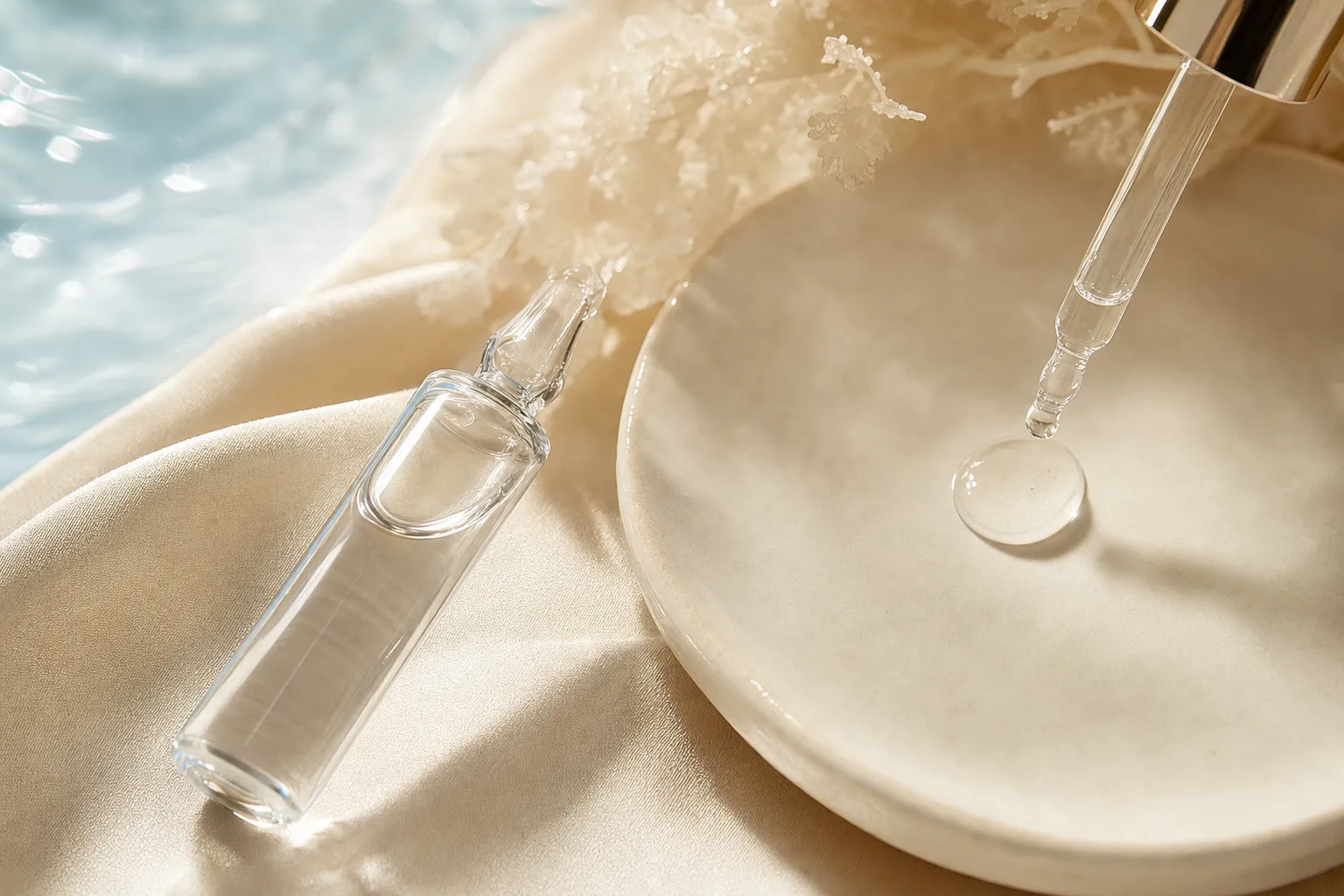
What a hyaluronic acid ampoule does for your skin
Hyaluronic acid is already in your skin, filling the space between cells and holding on to water. When you apply it, it is known for two things.
- Hydration: it holds water on the skin's surface, which eases that tight feeling after cleansing.
- Firmness and fine lines: in a 60-day study, creams with five different sizes of hyaluronic acid, each at 0.1%, all improved skin hydration and elasticity. The smaller molecules also reduced wrinkle depth (Pavicic et al., 2011).
Notice the amount in that study: 0.1%. Very little was enough to make a difference, so it is no surprise to find hyaluronic acid near the end of an ingredient list.
Why hyaluronic acid holds on to water
Hyaluronic acid strongly attracts and binds water molecules. Applied to skin, it leaves a thin water-holding layer on the surface, and the tight feeling eases.
Molecule size changes where it works. Large hyaluronic acid stays on the surface and holds water there, while smaller pieces are known to reach a little deeper. That difference is often used to explain why only the smaller molecules reduced wrinkle depth in the study above.
Hyaluronic acid draws water in but does not seal it, so it lasts longer under a cream that keeps the water from escaping. How moisturizing ingredients split the work is covered in the three steps of moisturizing, and the ingredient itself in the hyaluronic acid ingredient guide.
Which skin suits a hyaluronic acid ampoule
It is the easiest fit for dry skin that tightens soon after cleansing, and for skin that looks shiny on top but feels tight underneath. It is known for rarely causing allergic reactions, so sensitive skin can usually start without much worry.
Oily skin can use it too. It adds water without oil, so it stays light. It is a thick ingredient, though, so if you dislike stickiness, pick a runnier texture.
If fine lines bother you as well, look for the smaller form. Hydrolyzed hyaluronic acid on the list means the molecule has been cut into smaller pieces.
Hyaluronic acid ampoule vs serum: what actually differs
The short answer is that the name does not tell them apart. There is no set rule for what counts as an ampoule, and some products with "ampoule" in the name are filed as serums or essences.
Hyaluronic acid itself is common in both. Of the 2,426 full ingredient lists we have collected, 1,290 contain it, more than half. So instead of ampoule versus serum, look at which hyaluronic acid is inside and what it is paired with.
How to choose a hyaluronic acid ampoule
Hyaluronic acid works in very small amounts, so its position on the list cannot tell you how much is inside. Ingredients under 1% can be listed in any order. Look at these instead.
- The name used: lists more often say sodium hyaluronate than hyaluronic acid. It is the sodium form of the same ingredient family. Hydrolyzed hyaluronic acid is the form cut into smaller pieces.
- Mixed sizes: two or three hyaluronic acid names on one list suggest a formula that combines molecule sizes. The exact sizes are not shown on the list.
- Moisturizers that come with it: check for glycerin, panthenol or ceramides, which hold water or fill in the barrier. Nearly all of the 1,290 hyaluronic acid products in our collection also contain glycerin.
- Texture: it is a thick ingredient, so stickiness varies by product. If you dislike a tacky finish, pick a runnier texture.
Hyaluronic acid ampoule and serum products
We picked products where it is clear what the hyaluronic acid is paired with. Ampoules first.
- SKIN1004 Madagascar Centella Hyalu-Cica Plumping Ampoule pairs centella with hyaluronic acid, as the name says. It suits skin that wants hydration and soothing together.
- Aestura AtoBarrier365 Cera-Hyal Moisture Ampoule names both ceramide and hyaluronic acid. With one ingredient holding water and another filling in the barrier, it is a first look for dry, sensitive skin.
- Rejuhan Rejuran Turnover Ampoule Dual Effect and Wellage Hyper PDRN Repair Ampoule both lead with PDRN. Hyaluronic acid is a supporting moisturizer here, so keep that in mind if hyaluronic acid is what you want.
Among serums, The Ordinary Hyaluronic Acid 2% + B5 adds panthenol (vitamin B5) to hyaluronic acid, as the name says. Mediheal Low-Molecular Hyaluronic Acid Moisture Serum puts the small form in its name, Anua PDRN Hyaluronic Acid 100 Capsule Serum pairs it with PDRN, and COSRX The Hyaluronic Acid 3 Serum leads with hyaluronic acid. For a product not on this list, enter its name and we will analyze the ingredients.
How to apply a hyaluronic acid ampoule and what to watch
- When: apply it while your skin is still damp after cleansing. It works better when there is water to hold.
- Seal it in: always follow with cream, especially in dry, heated rooms.
- Amount: one moderate layer finished with cream is less sticky than several layers.
- Order: products differ, so follow the directions on the label.
Frequently asked questions
Can I use a hyaluronic acid ampoule every day?
Yes, morning and night. It is known for rarely causing allergic reactions. Ampoules often contain other active ingredients too, so take a break if it stings or reddens.
Is an ampoule better than a serum?
The name alone does not settle it, because there is no set rule separating the two. Choose by which hyaluronic acid is inside, what it is paired with, and how it feels on your skin.
Is sodium hyaluronate the same as hyaluronic acid?
It is the sodium form of the same ingredient family, and the name you will see most often on cosmetic labels. The differences between molecule sizes are covered in the hyaluronic acid ingredient guide.
Do hyaluronic acid ampoules have side effects?
Reactions to hyaluronic acid itself are uncommon. Stickiness can bother some people, and other ingredients in the product can irritate, so try a new product on a small area first.
Skin Warning
Ampoules often combine hyaluronic acid with other actives. Test a new product on the inner arm first, and stop use and consult a dermatologist if irritation continues.
VERIFIED DUPES
Verified dupe pairs featuring Hyaluronic acid: 508
Pairs confirmed by comparing both full ingredient lists.